
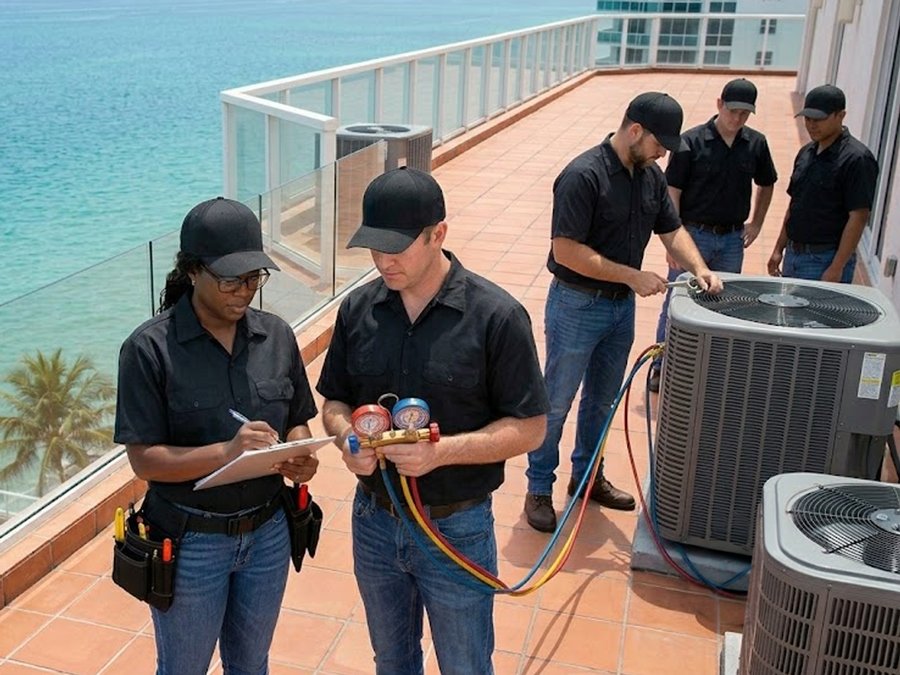


Florida has some of the most stringent HVAC permit requirements in the United States, and it’s not by accident.
The state’s hot-humid climate, hurricane exposure, and aggressive energy efficiency standards mean every HVAC install — even a like-for-like replacement — comes with a paperwork trail. If you’ve been told “you just need to swap the unit” by someone trying to skip a permit, this article is the reality check.
The HVAC permit requirements in Florida are spelled out in the Florida Building Code (FBC), 8th Edition (2023), and they apply statewide with even tighter rules in the High-Velocity Hurricane Zone covering Miami-Dade and Broward counties.
When an HVAC permit is required in Florida
Florida requires mechanical permits for all HVAC installations, replacements, and modifications — including like-for-like replacements. There is no exemption for equipment swaps. This is the single biggest difference between Florida and many other states, and it catches a lot of homeowners off guard when they discover that the contractor who replaced their condenser without pulling a permit just created a problem at resale.
Miami-Dade County goes further: permits are required for all HVAC work including repairs involving refrigerant circuit modifications. If a tech opens the sealed refrigerant loop, that’s permit territory in HVHZ.
The FBC, 8th Edition, adopted the 2021 IRC with Florida-specific amendments, including enhanced wind-resistance requirements for outdoor equipment (Florida Building Commission, 2023).
The FBC also requires ACCA-compliant Manual J load calculations for all HVAC permits. This isn’t optional, and it isn’t something the equipment manufacturer’s rule of thumb can substitute for.
Plan reviewers in Florida regularly reject submittals that arrive without a proper room-by-room load calculation, and the rejection is usually citation-specific — they’ll tell you exactly which line of the FBC you missed.
Florida-specific requirements that trip up out-of-state contractors
If you’re used to working in a state with looser mechanical codes, Florida’s requirements feel like a different planet.
Outdoor HVAC equipment must be installed on platforms that meet FBC wind-load requirements, and in the HVHZ, equipment must also be protected from windborne debris — that usually means hurricane-rated stands, tie-downs, or louvered enclosures tested to the FBC standard.
A condenser sitting on a standard concrete pad with no anchorage will fail inspection in Miami-Dade. Manual J calculations must use Florida-specific climate data, with summer design temperatures of 91 to 93 degrees F depending on location.
A Manual J built with default national assumptions or pulled from a neighboring state will undersize the cooling load and fail review — the humidity load matters as much as the sensible load in Florida, and the calculation has to reflect that.
Minimum SEER2 of 15.0 applies to split systems manufactured after January 1, 2023, which is the federal regional standard for the Southeast, enforced through the Florida Energy Conservation Code at permit submittal.
Ductwork in unconditioned attic spaces must be insulated to R-8 minimum, and energy compliance documentation per the FBC Energy Conservation chapter is required for the permit packet, separate from the Manual J.
Need Manual J calculated with Florida climate data and FBC-compliant outputs? Our HVAC Manual J, S, and D package is built for Florida submittals, and we can add a PE stamp for jurisdictions that require one.
The HVHZ adds another layer
The High-Velocity Hurricane Zone covers Miami-Dade and Broward counties, and HVAC permitting there is in a category of its own.
Beyond the standard FBC requirements, HVHZ submittals often need product approval numbers for outdoor equipment, hurricane stands, and any penetrations through the building envelope — equipment without a current Florida Product Approval listing won’t pass. Stricter anchoring details are required, showing how the condenser is fastened to the platform and how the platform is fastened to the structure, with calculations that meet the local wind-load criteria.
Permit drawings need to show equipment locations, refrigerant line routing, condensate discharge, and duct paths — not just an equipment cut sheet. PE-stamped drawings are required for many residential additions, new construction, and any project where the AHJ requires engineer review (Miami-Dade).
This is the most common reason out-of-state homeowners and contractors get blindsided.
A permit packet that would sail through review in Jacksonville will sit in plan check for weeks in Miami-Dade if it doesn’t include the HVHZ-specific items.
For Florida projects that need engineer-stamped drawings, our PE signed and sealed service covers Florida along with NJ and NY.
The Florida Energy Code side of the permit
Florida adopted the 2021 IECC with state-specific amendments as the Florida Energy Conservation Code, and it’s enforced at HVAC permit submittal.
The key requirements include duct leakage testing with maximum total leakage of 6 percent of airflow (verify the exact threshold for your jurisdiction and adopted amendments, since some local AHJs apply alternate pathways), air leakage testing with a maximum 5 ACH50 for new construction, and minimum insulation levels based on Florida’s climate zones — R-30 for ceilings in South Florida and R-38 in North Florida.
REScheck or Florida-specific compliance software is required for permit submittal. For most replacement projects, the energy code piece is straightforward and the Manual J does the heavy lifting.
For new construction and additions, you’ll need the full envelope documentation alongside the HVAC documents, and they have to be internally consistent — the window U-factors in your Manual J inputs have to match the REScheck, the equipment in your Manual S has to meet the federal minimum, and so on.
Plan reviewers flag inconsistencies fast.
What a permit-ready HVAC submittal looks like in Florida
For a typical residential HVAC permit in Florida, the packet usually includes:
- Manual J load calculation: A room-by-room load calculation using Florida climate data.
- Manual S equipment selection: A document showing the chosen unit matches the Manual J load and meets SEER2 minimums.
- Manual D duct design: With airflow, sizing, and static pressure calculations.
- Equipment cut sheets: With AHRI certificates and Florida Product Approval numbers.
- Energy compliance report: A REScheck or FBC report for new construction and additions.
- PE-stamped drawings: Where required by the AHJ (common in HVHZ, additions, and new builds).
- Site or equipment location plan: Showing condenser placement, anchorage, and clearances.
Important notes for approval
-
- Skipping any of these is the fastest way to get bounced.
- Plan reviewers see this packet structure every day, and incomplete submittals go to the back of the queue.
References
- Florida Building Commission. (2023). Florida Building Code (8th ed.). https://floridabuilding.org/fbc/fbc.aspx
- Miami-Dade County. Mechanical permits. https://www.miamidade.gov/global/economy/building/permits/mechanical.page
- Air Conditioning Contractors of America. (2016). Manual J: Residential Load Calculation (8th ed.). ACCA. https://www.acca.org/standards/technical-manuals/manual-j